

When the BLAKE2b hard fork split from Bitcoin, one of its core selling points was democratising mining by abandoning SHA-256d for an algorithm that’s friendlier to CPUs and GPUs; the change promised to sideline the industrial ASIC farms that dominate Bitcoin mining and hand the network back to ordinary miners with consumer hardware.
It’s a compelling pitch. But there are no free lunches in Bitcoin; every decision has a trade-off.
It’s also a pitch that’s already been tried, tested, and defeated, with plenty of altcoins providing receipts — and the evidence is sitting in warehouses right now, in the form of Siacoin ASIC miners that are perfectly capable of pointing their hashpower at any chain running BLAKE2b.
The ASIC Problem Doesn’t Disappear, It Just Waits
Siacoin has run on the BLAKE2b algorithm since its early years, and the mining hardware market responded exactly the way it always does when there’s money to be made: specialised silicon arrived.
Obelisk’s SC1 miner, followed by Halong’s DragonMint BLAKE2b unit, and eventually Goldshell’s SC-series line, turned Siacoin mining into a fully ASIC-dominated market, with GPU mining effectively priced out of profitability years ago.
The lesson here is that BLAKE2b was never actually ASIC-resistant. It just took a few product cycles for manufacturers to test the market to see if it was profitable enough to build hardware to support the algorithm.
That hardware doesn’t disappear once a chain like Sia falls out of favour — it sits in racks, owned by operators who are constantly scanning for the next profitable place to point it.
If a BLAKE2b-based Bitcoin fork gains enough value to make mining worthwhile, existing Siacoin ASIC fleets are a near-instant source of industrial-scale hashpower, no R&D cycle required.
The CPU/GPU-friendly window that makes a freshly launched algorithm feel “decentralised” is really just the gap between launch and the moment ASIC manufacturers decide the reward justifies the tooling cost.
History suggests that gap is measured in months, not years.
Data Centres Are an Even Bigger Player Than Dedicated ASICs
While custom ASICs have a limited supply and it will take a while to spin up more should Blake2b gain traction, there’s another player with pretty deep pockets ready to out-hash any pleb operation. Arguably more dangerous centralising force at play here too: general-purpose compute infrastructure.
The current AI boom has filled the world with enormous GPU and CPU data centres, many of which don’t run at full utilisation around the clock. A chain that can be mined competitively on GPUs or CPUs is a chain that every one of those data centres can opportunistically point idle capacity toward, the moment profitability makes sense.
This is a meaningfully different threat than ASIC centralisation, because of how allocation decisions work. A data centre operator running SHA-256d ASICs has to make a discrete infrastructure choice — dedicate physical rack space, power delivery, and cooling specifically to mining hardware that does nothing else.
It’s a sunk, single-purpose capital commitment.
But a data centre already running GPU or CPU clusters for AI inference and training doesn’t have to choose between AI and mining in the same binary way — it can simply reallocate idle cycles between workloads dynamically, mining during off-peak demand and switching back to AI compute when a paying customer’s job comes in.
That flexibility means the barrier to these operators becoming a dominant mining force isn’t a capital expenditure decision at all—it’s a software scheduling decision. When the economic incentive to mine exceeds the opportunity cost of idle GPU time, hyperscale AI infrastructure becomes a mining centralisation vector that’s arguably easier to activate than building purpose-built ASIC farms ever was.
Monero’s Experience: The Cure Has Its Own Side Effects
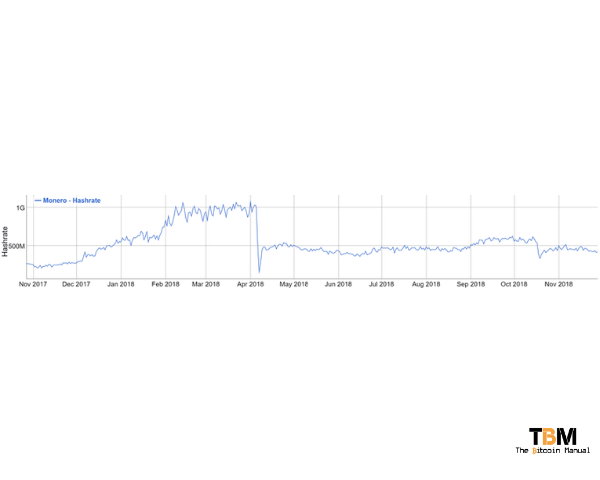
Monero is the most prominent real-world case study in trying to fight this dynamic head-on, and its experience is instructive precisely because it shows the costs of the “solution,” not just the problem. Monero has repeatedly hard-forked its hashing algorithm — moving through CryptoNight variants and eventually to RandomX — specifically to keep ASIC manufacturers from gaining a permanent foothold. Each time ASIC vendors got close to producing competitive hardware, Monero changed the rules underneath them.
It’s worked, in the narrow sense that no ASIC has permanently dominated Monero mining the way SHA-256d ASICs dominate Bitcoin.
But it hasn’t been free.
Every algorithm change is itself a significant engineering and coordination effort — new client software, new pool software, new mining software, and a period of network uncertainty around each transition.
Each fork also causes real disruption to the existing miner base: hashrate visibly drops around every algorithm change as miners scramble to update software, some hardware becomes instantly worthless, and the network’s security temporarily weakens while the dust settles.
Regularly changing algorithms trades one problem (ASIC centralisation) for another (recurring operational fragility and a permanent tax of engineering complexity that has to be paid indefinitely, forever, to keep the arms race going). It’s not a solved problem — it’s a maintenance commitment with no end date.
Losing What Industrial Mining Actually Does Well
There’s also a less-discussed trade-off in deliberately pushing mining toward small-scale CPU and GPU operations: you lose the genuine infrastructure benefits that come with large, industrial-scale mining operations.
Modern Bitcoin mining facilities increasingly integrate with real energy infrastructure in ways that create value well beyond simply producing blocks — flaring gas that would otherwise be wasted at oil sites, absorbing curtailed renewable energy that grid operators can’t otherwise use, and increasingly, reusing waste heat for practical purposes like district heating or industrial processes.
None of that is meaningfully possible at the scale of scattered CPU and GPU miners running in bedrooms, offices, or repurposed AI data centre cycles. You don’t get gas-flaring mitigation from someone’s gaming GPU.
You don’t get useful district heating from a handful of consumer CPUs.
The efficiency, waste-heat reuse, and grid-balancing benefits that make industrial mining a genuinely productive economic actor rather than just an electricity consumer are byproducts of scale and purpose-built infrastructure — exactly the qualities that algorithm-hopping strategies are trying to eliminate.
In trying to fight centralisation, you can inadvertently discard the operational sophistication that makes large-scale mining a net positive for energy systems in the first place.
Decentralising Without Chasing Algorithms
If the goal is to reduce mining centralisation rather than displace it temporarily, Bitcoin already has more promising tools that don’t require the recurring cost and disruption of algorithm changes.
Miner-controlled block templates are probably the most significant of these. Projects like Stratum V2 and DATUM let individual miners — not just mining pool operators — construct their own block templates, choosing which transactions to include rather than simply pointing hashpower at whatever template a centralised pool hands them. This directly attacks the real centralisation risk in Bitcoin mining today, which isn’t really about ASIC ownership at all — it’s about the small handful of pool operators who currently decide block contents for the majority of the network’s hashrate.
Decentralised pool protocols, where reward distribution and share validation happen without a single trusted pool operator controlling payouts, reduce the risk of any one entity censoring transactions or unilaterally influencing block construction.
Geographic and jurisdictional diversity incentives — whether through market forces, community pressure, or transparent public reporting on pool and hashrate concentration — help keep visibility on where centralisation risk is actually accumulating, since the problem is rarely the hardware itself but who controls the decision-making layered on top of it.
Am I saying that these solutions stop the forces of mining centralisation in their tracks? No, but none of these requires destabilising the network’s proven, battle-tested SHA-256d security model, and none creates the recurring engineering tax Monero has had to pay repeatedly. They focus on the locus of centralisation — decision-making power over block construction and reward distribution — rather than treating “which chip architecture is currently profitable” as the real problem.
These are not perfect solutions, and market participants can choose to ignore them, but they are building blocks for alternative hash rate production that can bypass centralised pressure and capture.
Keeping The Network Robust
Changing a chain’s hashing algorithm is a tempting, visually satisfying way to signal a break from ASIC-dominated mining, but it’s a temporary state, not a permanent fix. The more durable path to reducing mining centralisation isn’t fighting over which hardware wins the arms race.
It’s decentralising who decides what goes into a block in the first place, where there is still plenty of work to be done, and OFAC compliance or state attacks to prove why it’s needed.