
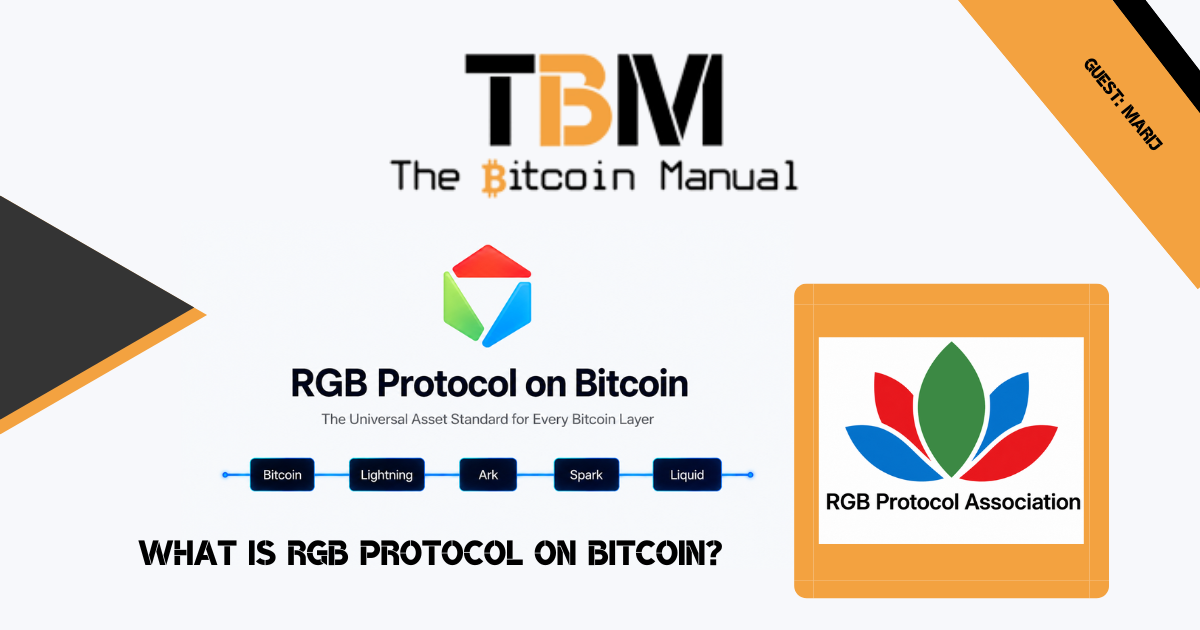
RGB Protocol on Bitcoin (v0.11.1) is an open-source protocol for issuing and transferring digital assets directly on Bitcoin and the Lightning Network, without any change to Bitcoin’s base layer. It is not a third layer stacked on top of Lightning: RGB runs on Bitcoin’s base layer (Layer 1) and integrates natively with Lightning (Layer 2). Exchanges happen peer-to-peer without involving any trusted third party.
The Problem RGB Solves
Every major blockchain used for tokens today stores asset data publicly and permanently. Every node keeps a full copy of every balance and every transfer, forever. That approach is great for securing a global monetary ledger like Bitcoin, but it’s a liability for digital assets: the chain gets heavier with every issuance, privacy disappears, and scalability turns into the exception instead of the rule.

Early attempts to bring assets to Bitcoin, like colored coins, needed every participant to scan and validate the entire blockchain just to track who owned what.
Those systems were slow, privacy-invasive, and hard to scale past a handful of users.
RGB was built to avoid that trade-off. It keeps Bitcoin’s security model while moving asset data off-chain, and it’s been running in production since RGB Protocol on Bitcoin v0.11.1 reached mainnet in July 2025.
How Does RGB Work?
RGB Protocol on Bitcoin uses client-side validation: only the two parties in a transfer exchange and validate the actual contract data. Instead of broadcasting balances and transfer history to the whole network, the Bitcoin blockchain stores nothing more than a small cryptographic commitment proving a transfer took place.
Think of it like a notarized private agreement: Bitcoin, the notary, confirms something happened at a specific time without ever reading what’s inside.
The full package of contract data, called a consignment, passes directly between sender and receiver, and each recipient validates it locally, the same way you’d check a signed document handed to you in person instead of trusting a public registry to vouch for it.
To stop double-spending, RGB ties every asset to a Bitcoin UTXO through a mechanism called a single-use seal. Once that UTXO is spent, the seal breaks and the state moves forward, with Bitcoin’s blockchain acting as an immutable timestamp for every step.
Contract logic runs on AluVM, RGB’s own virtual machine. It’s deliberately kept simple, so every contract finishes running in a predictable way instead of risking the runaway behavior possible on more open-ended systems like Ethereum.
What RGB Adds to Bitcoin
- Privacy by default. Balances, transfer history, and contract logic never touch the chain. An outside observer sees a standard Bitcoin transaction and can’t tell whether an RGB asset was involved, who holds it, or how much moved.
- No blockchain bloat. Asset data lives off-chain, so all Bitcoin ever sees is a commitment of a few bytes, tucked into a transaction output.
- Lightning-native speed. RGB validation happens off-chain, so RGB assets move through Lightning channels instantly and for negligible fees, through dedicated RGB-compatible Lightning nodes, with no separate settlement layer required.
- Bitcoin’s own security, nothing added. Ownership is tied directly to UTXO control, the same model Bitcoin itself uses. No validators, no federations, and no extra parties to trust.
- Flexible by design. A single protocol covers fixed-supply tokens, inflatable tokens, collectibles, non-fungible assets, and permissioned assets that require issuer approval on every transfer. Each of them is validated the same way.
RGB: The Universal Asset Standard for Bitcoin
Bitcoin’s layer 2 ecosystem has grown fast. Lightning, Ark, Spark, Liquid, and a handful of statechains are all live or close to it, and each has started building its own token standard: Taproot Assets on Lightning, Ark’s native tokens, Spark tokens, Liquid assets: four different standards for four different networks, incompatible with each other by default.
At the Tuscany Lightning Summit 2026, Federico Tenga, co-founder of the RGB Protocol Association, made the case that RGB Protocol on Bitcoin is positioned to solve that fragmentation instead of adding to it, describing RGB as the universal asset standard for Bitcoin’s multi-layer ecosystem. Because RGB assets are tied to Bitcoin UTXOs rather than to any single layer’s rules, any Bitcoin layer that can move a UTXO can also move an RGB asset alongside it, without custom integration work for each new network.
Renat Skitsan, CTO of Utexo, reached a similar conclusion independently. He described RGB as a meta protocol: something that works on top of any UTXO-based system, Bitcoin’s base layer included, rather than a standard tied to one specific network.
The practical upside for issuers is that they only integrate once. An asset issued on RGB today can move to Ark, Spark, or a future layer tomorrow, without the issuer taking any action, or even knowing about it.
USDT is Coming to RGB
In August 2025, Tether officially announced plans to launch USDT on RGB Protocol on Bitcoin. Paolo Ardoino, CEO of Tether, said:
“Bitcoin deserves a stablecoin that feels truly native, lightweight, private, and scalable. With RGB, USD₮ gains a powerful new pathway on Bitcoin, reinforcing our belief in Bitcoin as the foundation of a freer financial future.”
As of August 2026, Utexo is building the infrastructure to bring that USDT onto Bitcoin, and is getting ready to ship the following:
- A bridge that locks and mints. USDT gets locked on the chain where it already lives, such as Ethereum or Tron, and an equivalent amount is minted on Bitcoin through RGB. Sending it back works the same way in reverse, built so no single party can approve a transfer alone, keeping the process secure.
- Toolkits for existing wallets. Wallets that already hold USDT on chains like Ethereum and Tron won’t need to be rebuilt from scratch: Utexo’s toolkits let them plug in RGB and Lightning support directly, covering most major wallet platforms.
- A Lightning module for Tether’s own Wallet Development Kit (WDK). WDK is the modular framework used to build self-custodial wallets across the Tether ecosystem; this module gives any WDK-based wallet a direct path to RGB on-chain and Lightning support.
Skitsan was clear that the goal isn’t another speculative use case. Stable, low-fee, borderless USDT payments already have real demand — RGB gives that demand a way to settle natively on Bitcoin and move on to Lightning, Ark, or any future layer without leaving the ecosystem RGB is building.
RGB Keeps Shipping
RGB Protocol on Bitcoin’s been on mainnet since v0.11.1 shipped in July 2025, and development hasn’t slowed down since. As of August 2026, the most recent release is RC11, a maintenance update that closed two validation edge cases in how the protocol checks transactions.
The related ecosystem is growing alongside the protocol itself:
- KaleidoSwap: a decentralized exchange for RGB assets over Lightning
- LNFI Network: a DEX and DeFi infrastructure layer for RGB assets
- Utexo: the USDT bridge and wallet infrastructure described above
- Iris Wallet (built by RGB-Tools) and Tribe RGB: wallets that already support RGB on Android and iOS
More integrations are shipping across the ecosystem regularly.
RGB Adds A Little Colour To The Orange Coin
RGB Protocol on Bitcoin lets developers issue and transfer digital assets natively on Bitcoin and Lightning, using client-side validation to keep asset data private and off-chain while Bitcoin itself provides the settlement guarantee. It’s been production-ready since v0.11.1 reached mainnet in July 2025, and the team keeps shipping: RC11 is only the latest release in an active development cycle.
With Tether bringing USDT to Bitcoin through RGB, and Federico Tenga’s case for RGB as the universal asset standard across Bitcoin’s layers gaining traction, RGB is emerging as more than one option among several for Bitcoin-native assets. It’s shaping up to be the standard the rest of the ecosystem builds on.
RGB Protocol on Bitcoin — in brief:
- Issues and transfers digital assets natively on Bitcoin and Lightning
- Uses client-side validation: asset data stays private and off-chain, and only a small cryptographic commitment goes on Bitcoin
- Live on Bitcoin mainnet since July 2025 (v0.11.1), and still shipping — the latest release, RC11, landed in July 2026
- Positioned as the universal asset standard across every Bitcoin layer: Lightning, Ark, Spark, and sidechains
- Tether is bringing USDT natively to Bitcoin through RGB, with Utexo building the infrastructure to move it
Where to Learn More
Resources such as rgbfaq.com and rgb-org.github.io are maintained by a separate organization (RGB-WG / rgb.tech) and don’t reflect the production v0.11.1 protocol.
RGB Protocol Association — rgb.info · docs.rgb.info