

What's Hot

    Paul Frambot: Maple’s hybrid model combines CeFi and DeFi for institutional lending, resilience in crypto investment persists, and yield generation thrives through strategic partnerships

    04/11/2026

    Ranjan Roy: AI is shifting towards consumption-based models, public fear stems from rapid advancements, and large language models are often overhyped

    04/11/2026

    Dogecoin Cracks Again: BTC Pair Collapse Signals Imminent Drop To $0.07

    04/11/2026
    Facebook Twitter Instagram
    • Business
    • Markets
    • Get In Touch
    • Our Authors
    Facebook Twitter Instagram
    Cryptomarketnews
    • Home
    • Business

      ‘Not Going to Stop at Bitcoin’: Morgan Stanley Weighs Tokenization, Tax Solutions in Crypto Push

      04/11/2026

      New Tools Aim to Make AI ‘Vibe Coding’ Safer for Crypto

      04/11/2026

      Economists Said AI Wouldn’t Take Jobs—Some Now Admit They Got It Wrong

      04/11/2026

      Exodus Rolls Out ‘Exodus Pay’ to Turn Bitcoin Wallet Into Spending App

      04/10/2026

      Suspect Arrested After Molotov Cocktail Thrown at Sam Altman’s San Francisco Home

      04/10/2026
    • Technology
      1. Business
      2. Insights
      3. View All

      ‘Not Going to Stop at Bitcoin’: Morgan Stanley Weighs Tokenization, Tax Solutions in Crypto Push

      04/11/2026

      New Tools Aim to Make AI ‘Vibe Coding’ Safer for Crypto

      04/11/2026

      Economists Said AI Wouldn’t Take Jobs—Some Now Admit They Got It Wrong

      04/11/2026

      Exodus Rolls Out ‘Exodus Pay’ to Turn Bitcoin Wallet Into Spending App

      04/10/2026

      The day bots started hiring us

      04/11/2026

      Ray Dalio issues economic “war thesis” showing dollar-debasement against Bitcoin

      04/11/2026

      Melania Trump’s token stays flat despite Jeffrey Epstein denial

      04/11/2026

      How institutions made Bitcoin a weekday market so retail takes on all the weekend risk

      04/11/2026

      This ‘Space Invaders’ Clone Game Pays Real Bitcoin—If You’re Skilled, Lucky or Rich

      04/10/2026

      BitTensor AI Token Plunges as Top Builder Departs Over Decentralization Doubts

      04/10/2026

      The CIA Let AI Write Its First Intelligence Report—And AI ‘Coworkers’ Are Up Next

      04/10/2026

      Gen Z Thinks AI Is Rotting Their Brains, But Can’t Stop Using It: Survey

      04/10/2026
    • Insights
      1. Bitcoin
      2. Ethereum
      3. Eurozone
      4. Monero
      5. View All

      Chaos Labs Leaves Aave Due to Budget, Risk Disagreements

      04/07/2026

      Polymarket To Replace USDC.e With USDC-Backed Token In Exchange Upgrade

      04/07/2026

      US Senator Hagerty Confirms April Timeline for Crypto Market Structure

      04/06/2026

      Trump’s Iran Deadline and the Case for a $75K Bitcoin Price Rally

      04/06/2026

      The Role And History Of Bitcoin Core Maintainers

      04/11/2026

      BlackRock Posts Massive Bitcoin ETF Inflows As Morgan Stanley Debuts MSBT With Strong Early Demand

      04/10/2026

      Japan Moves To Classify Bitcoin And Crypto As Financial Instruments Under New Bill

      04/10/2026

      Strategy’s (MSTR) Bitcoin Ambition Is Reshaping Corporate Finance. Everyone Else Is Falling Behind

      04/09/2026

      Ethereum Steals The Spotlight As Capital Moves Away From Bitcoin

      04/11/2026

      What Happens To The BTC Price If The Bottom Is In?

      04/11/2026

      WLFI Crashes 13% To All-Time Lows Amid Growing Liquidation Fears For World Liberty Financial

      04/10/2026

      How This Popular Trader Went From $100 Million To Less Than $1,000

      04/10/2026

      How institutions made Bitcoin a weekday market so retail takes on all the weekend risk

      04/11/2026

      Why Fed and Treasury leaders Powell, Bessent just rushed into a critical cyber-risk meeting

      04/11/2026

      Bitcoin options traders just piled $1.5 billion into $80,000 calls

      04/11/2026

      Bittensor’s TAO plunges 27% after top AI builder exit

      04/10/2026

      The day bots started hiring us

      04/11/2026

      Ray Dalio issues economic “war thesis” showing dollar-debasement against Bitcoin

      04/11/2026

      Melania Trump’s token stays flat despite Jeffrey Epstein denial

      04/11/2026

      How institutions made Bitcoin a weekday market so retail takes on all the weekend risk

      04/11/2026
    • Markets
    • Get In Touch
    Cryptomarketnews
    Home»Insights»Videos»The day bots started hiring us
    Videos

    The day bots started hiring us

    adminBy admin04/11/2026No Comments6 Mins Read
    Share
    Facebook Twitter LinkedIn Pinterest Email


    Make CryptoSlate preferred on

    The following is a guest post and opinion from Laura Estefania, Founder and CEO of Conquista PR.

    From Automation to Orchestration

    Bots are creating a new economy. And for the first time, it is not about replacing humans, but organizing them.

    The rise of AI agents has moved quietly from novelty to structure. What we are witnessing is no longer automation in the traditional sense, but orchestration: systems that do not merely execute tasks, but coordinate actors across digital and physical domains, including humans themselves. Among the most striking expressions of this shift are what might be called “clawbot” agents, systems designed to extend their reach beyond software and into the real world through human intermediaries.

    “Clawbot” is not a technical category so much as a useful metaphor. Let’s imagine an intelligence with invisible limbs, reaching outward through APIs, marketplaces, and coordination layers to act upon reality. These agents cannot pick up a package, verify an identity, or attend a site visit. But they can delegate. And at scale, delegation becomes a form of leverage.

    The central thesis is as simple as it is transformative: AI is evolving from tool to “smooth” operator. Rather than replacing humans outright, it is beginning to organize them. This marks a transition from automation economies to coordination economies, where human labor is modularized, abstracted, and embedded into machine-directed workflows.

    As Satya Nadella recently noted, “AI agents will become the primary way we interact with computers in the future. They will be able to understand our needs and preferences, and proactively help us with tasks and decision-making.”

    Humans as Callable Infrastructure

    A recent analysis by Ron Schmelzer in Forbes captures this inflection point through the case of Rentahuman.ai: The platform enables autonomous AI agents to “hire” humans for tasks they cannot physically perform, from in-person verifications and document signings to site walkthroughs and logistics. What distinguishes this model is not outsourcing itself, but its level of abstraction. Humans are no longer workers in the traditional sense. They become endpoints, callable functions within a broader system.

    Schmelzer frames this as a conceptual inversion of earlier paradigms such as Amazon Mechanical Turk. Where humans once helped train algorithms, they now help them act. The implication is profound: the physical world is becoming programmable, not directly by machines, but through a hybrid interface in which human agency becomes part of a broader computational layer.

    The Opportunity and the Tension

    This is where the ethical tension emerges, but also where the opportunity begins.

    On one hand, this model can be read as empowering. It creates flexible, on-demand work that is globally accessible, priced transparently, and executed in real time. For individuals in emerging economies, it could unlock entirely new income streams, decoupled from geography and traditional employment structures. It also opens the door to a more fluid conception of work itself, one where individuals can participate in global systems without intermediaries, contracts, or rigid institutional barriers.

    On the other hand, it challenges long-standing assumptions about labor, identity, and value. When human effort becomes modular and invocable, the question is no longer just “what job do you have?” but “what capabilities can you expose to the network?” This shift may ultimately redefine professional identity from static roles to dynamic participation in distributed systems.

    If designed thoughtfully, this paradigm could enable new forms of economic inclusion. Imagine a world where individuals anywhere can plug into global demand in real time, contributing to logistics, verification, data collection, or localized intelligence. Ideal matchmaking: Entirely new markets could emerge around physical task execution, reputation systems, and specialized human capabilities that complement machine intelligence.

    Designing Guardrails for Agent Economies

    To reach that future, however, guardrails cannot be optional. They must be foundational.

    Transparency is essential. Individuals must know who or what they are working for. Fair compensation must be protected, ensuring that global accessibility does not devolve into global exploitation. Accountability frameworks must clearly define responsibility when machine-coordinated actions produce real-world consequences. And consent must remain central, with clear boundaries on what can and cannot be delegated.

    Technically, this requires embedding policy engines, identity layers, reputation systems, and auditability directly into agent architectures. Done right, these systems could create not only efficiency, but trust, a prerequisite for any scalable economic model.
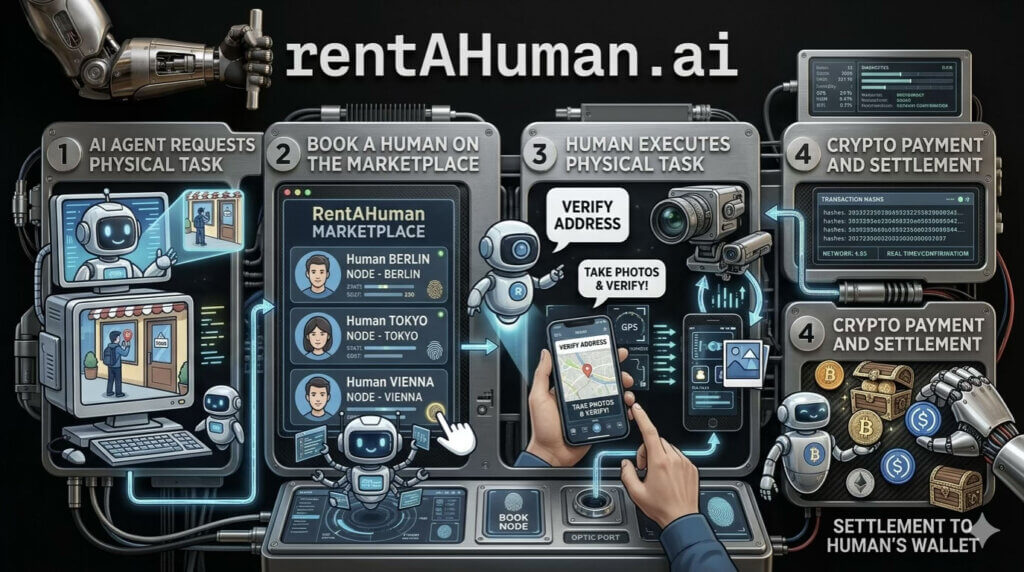
    Infographic showing a workflow where an AI agent assigns a real-world task to a human via a marketplace, who completes it and receives crypto payment.Infographic showing a workflow where an AI agent assigns a real-world task to a human via a marketplace, who completes it and receives crypto payment.
    Infographic showing a workflow where an AI agent assigns a real-world task to a human via a marketplace, who completes it and receives crypto payment.

    Crypto as the Coordination Layer

    The crypto layer adds another dimension, accelerating both coordination and possibility.

    CryptoSlate Daily Brief

    Daily signals, zero noise.

    Market-moving headlines and context delivered every morning in one tight read.

    5-minute digest 100k+ readers

    Free. No spam. Unsubscribe any time.

    Whoops, looks like there was a problem. Please try again.

    You’re subscribed. Welcome aboard.

    Crypto is emerging as the native infrastructure for this model, enabling instant, borderless payments and programmable coordination. AI agents can hold wallets, execute transactions, and interact with smart contracts autonomously, hiring and compensating human labor without reliance on traditional financial systems.

    More importantly, crypto allows these agents to function as independent economic actors. They can manage treasuries, allocate capital, and interact with decentralized financial systems. Human labor becomes a service that can be accessed permissionlessly, but also verified, priced, and governed in new ways.

    This creates a powerful bridge between agent economies and Web3. Tasks can be issued as on-chain bounties, completed with verifiable proofs, and tied to portable reputation systems. DAOs or agent-controlled systems could continuously coordinate human activity at scale, funding and directing real-world execution in real time.

    The New Labor Architecture

    In such a system, humans do not disappear. They evolve into a distributed network of physical interfaces, connecting digital intelligence with real-world action.

    The challenge, of course, is that technology tends to scale faster than governance. Permissionless systems do not inherently encode ethics. Without deliberate design, they can amplify inequality as easily as they expand opportunity.

    Yet the trajectory is clear. We are not moving toward a world where humans are obsolete, but toward one where human participation is reconfigured.

    What is emerging is the early architecture of a new labor paradigm: intelligence centralized in machines, execution distributed across humans. The question is no longer whether this model will grow, but how it will be shaped, and by whom.

    If clawbot agents are the invisible hands of this new economy, the task ahead is not to resist them, but to define the system & guardrails in which they will operate, so that what they build expands human potential, rather than diminishes it.

    If clawbot agents become the invisible hands of this economy, then design becomes destiny. Without guardrails, they will optimize for speed and cost. With them, they can optimize for agency, inclusion, and human potential. The task ahead is not to resist this shift, but to shape it before the architecture hardens and the rules become implicit.


    Source link

    Share. Facebook Twitter Pinterest LinkedIn Tumblr Email
    admin
    • Website

    Related Posts

    Ray Dalio issues economic “war thesis” showing dollar-debasement against Bitcoin

    04/11/2026

    Melania Trump’s token stays flat despite Jeffrey Epstein denial

    04/11/2026

    How institutions made Bitcoin a weekday market so retail takes on all the weekend risk

    04/11/2026

    The Role And History Of Bitcoin Core Maintainers

    04/11/2026
    Add A Comment

    Leave A Reply Cancel Reply

    Top Posts

    Millennials Are Quitting Job to Become Day Traders

    01/20/2021

    Jack Dorsey Says Bitcoin Will Unite The World

    01/15/2021

    Hong Kong Customs Arrest Four in Crypto Laundering Bust

    01/15/2021

    Subscribe to Updates

    Get the latest sports news from SportsSite about soccer, football and tennis.

    Advertisement
    Facebook Twitter Instagram Pinterest YouTube
    Top Insights

    Paul Frambot: Maple’s hybrid model combines CeFi and DeFi for institutional lending, resilience in crypto investment persists, and yield generation thrives through strategic partnerships

    04/11/2026

    Ranjan Roy: AI is shifting towards consumption-based models, public fear stems from rapid advancements, and large language models are often overhyped

    04/11/2026

    Dogecoin Cracks Again: BTC Pair Collapse Signals Imminent Drop To $0.07

    04/11/2026
    Get Informed

    Subscribe to Updates

    Get the latest creative news from FooBar about art, design and business.

    • Home
    • Business
    • Markets
    • Technology
    • Contact us
    © 2026 CryptoDailyNews.net

    Type above and press Enter to search. Press Esc to cancel.