


In brief
- Google just released Veo 3.1 Lite.
- The new model generates videos at faster speeds and much cheaper prices than otheer models from Google.
- The release comse days after OpenAI shut down its generative video project, Sora.
Google has a new AI video model for developers, and it’s cheaper—significantly cheaper—than what came before.
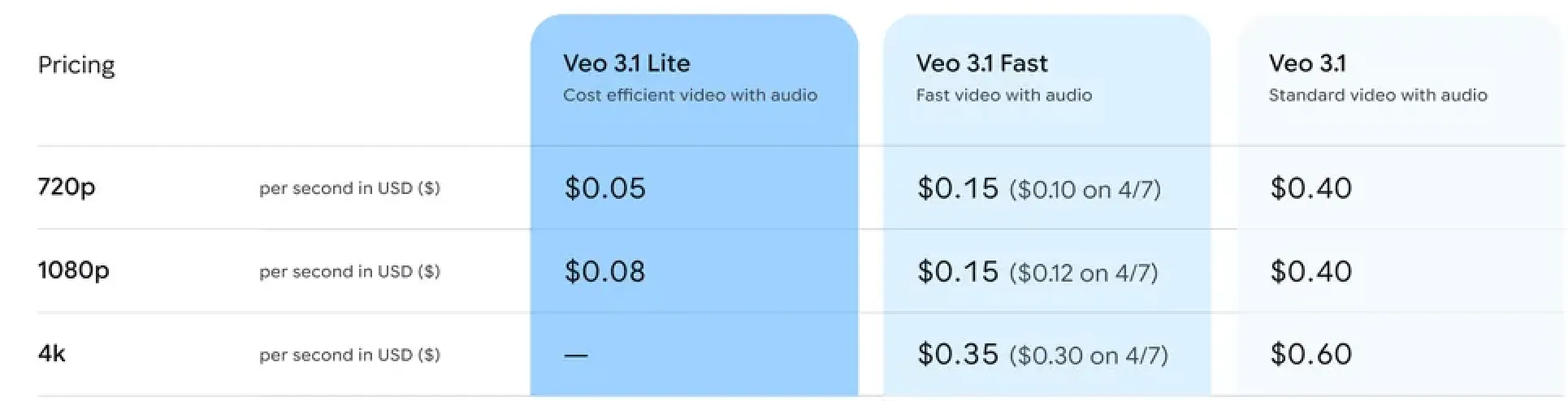
Veo 3.1 Lite launched this week through the Gemini API at less than half the cost of Veo 3.1 Fast, the mid-tier option in Google’s video generation lineup. The model supports Text-to-Video and Image-to-Video in both landscape (16:9) and portrait (9:16) formats, at 720p and 1080p resolution. Video duration is adjustable at 4, 6, or 8 seconds, with cost scaling accordingly.
To put that in perspective: Veo 3.1 previously cost around $0.40 per second of generated video with audio through the API, while Veo 3.1 Fast ran $0.15 per second. Lite brings that floor down to $0.05 per second for 720p—finally making high-volume video applications financially viable for smaller creators
We tried the model and the generations turned out very fast without showing a major degradation in quality. An 8 second video (the longest available) took less than 1 minute to generate. The prompt adherence was respectable, showing a minor glitch in the lettering. Other than that, the difference between Veo 3.1 Lite and Veo 3.1 Fast is not as noticeable as the difference between Veo 3.1 Fast and the original full version of Veo 3.1
Google didn’t stop at pricing its new model competitively. On April 7, pricing for Veo 3.1 Fast is also dropping. The company said it “rounds out the Veo 3.1 model family, giving developers flexibility based on needs.” The message to builders is clear: Pick your tier, not your ceiling.
This matters because cost has always been the dirty secret of AI video generation. The outputs look great in demos but those are usually handpicked generations and video AI is still too random to use consistently.
OpenAI found out the hard way. Sora was reportedly burning $15 million per day, and the company announced last week it was shutting the product down entirely. OpenAI is now “pivoting to world simulation research to advance robotics”—which is a very corporate way of saying it didn’t work out. A $1 billion deal with Disney got caught in the wreckage.
Veo 3 launched in May 2025 as Google’s loudest AI showcase, positioned as an all-in-one generator that produced not just video but full soundtracks—ambient noise, effects, even dialogue. Then came Veo 3.1 in October, going head-to-head with Sora 2. The quality was impressive, but the price tag wasn’t exactly inviting for anyone trying to ship something at scale.
Chinese competitors spotted that gap early. Kuaishou’s Kling AI has been offering comparable video generation at much cheaper prices than Google’s $250 Ultra plan and even the $20 pro alternative. Tencent’s Hunyuan Video went even further, releasing an open-source model for free, timed to land during OpenAI’s 2024 Sora launch hype cycle. The Chinese market doesn’t just compete on quality. It competes on economics, and it has been winning that argument for a while.
On the professional end, tools like Utopai’s PAI are carving out a completely different niche: long-form cinematic storytelling with consistent characters, detailed storyboards, and AI-driven editing at the scene level. PAI isn’t cheap—$100 for 10,000 credits that burn fast—but it signals where serious creators are going. They want control, not just generation.
Veo 3.1 Lite isn’t trying to be PAI’s cinematic pipeline, and it isn’t trying to beat Kling on price. It’s aiming at the middle: developers who need to ship video features at scale without hemorrhaging API credits on every iteration. The model is Google’s infrastructure play for the next generation of apps that treat video as a standard component, not a premium trick.
If the April 7 price cut for Veo 3.1 Fast follows through as promised, the cost of building with AI video drops across Google’s entire lineup in one week.
Daily Debrief Newsletter
Start every day with the top news stories right now, plus original features, a podcast, videos and more.
