
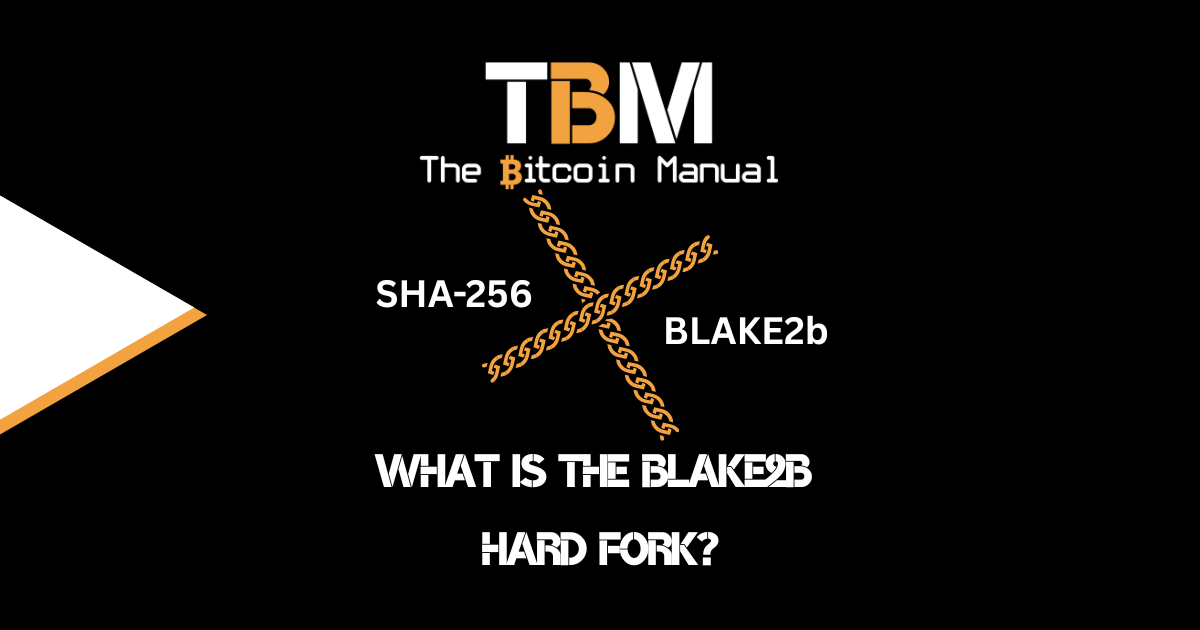
If you’ve seen the term “Blake2B” floating around Bitcoin forums and X threads, and you’re wondering what on earth these guys are going on about, it’s almost certainly BLAKE2b — the proof-of-work algorithm at the centre of Bitcoin’s recent hard fork attempt.
It’s been one of those months in Bitcoin where a year happens: from the COLDCARD Hack, a UASF and serious hard fork chatter (in eCash and Blake2b), it’s been busy.
I’m not going to catch you up on all the lore; for that, you’ll have to head back to the launch of Ordinals, but with the growth of arbitrary data use in Bitcoin transactions, the anti-spam/pro-monetary-use-only Bitcoin crowd has been looking for a solution.
It started with protests like running Knots to maintain filters, which Bitcoin Core later removed; then it morphed into BIP 110, a user-activated soft fork to restrict arbitrary data storage on Bitcoin, which didn’t activate the way its proponents hoped.
Instead of accepting that consensus failed, the movement has shifted its goals to something more drastic, morphing into a more aggressive solution: an entirely separate blockchain, secured by a different mining algorithm, that split from Bitcoin on August 8, 2026.
From Soft Fork to Hard Fork
BIP 110 was originally conceived as a UASF — a user-activated soft fork designed to reimpose strict limits on arbitrary data storage (like the large OP_RETURN payloads and inscription-style data enabled by more permissive recent Bitcoin Core policy). As covered previously, a soft fork only works cleanly if enough of the network — ideally an overwhelming majority of both nodes and miners — comes along with it.
That’s not what happened here.
On August 8, 2026, nodes enforcing BIP 110 stopped accepting blocks that didn’t comply with its restrictions. But the vast majority of Bitcoin’s SHA-256 mining power kept producing blocks under the old rules anyway, meaning the “money-only” soft fork rules simply couldn’t achieve economic and hashrate dominance the way SegWit’s UASF eventually did in 2017.
Rather than the new rules taking over the main chain, the BIP 110-enforcing nodes found themselves stuck on a minority chain, with mainstream SHA-256 mining power continuing to build the chain everyone still recognises as Bitcoin.
Faced with that reality, BIP 110’s most vocal advocate, longtime Bitcoin Core contributor Luke Dashjr, pivoted the project from a soft fork to a hard fork via a chance hashing-algorithm proposal—which would split off an independent blockchain and token distinct from Bitcoin.
This is a materially different outcome than what BIP 110 originally proposed, and it’s worth being clear about that distinction: a soft fork that fails to achieve majority support just fizzles or forces a re-think; a hard fork that fails to achieve majority support survives, technically, but as an entirely separate, minority coin.
Why BLAKE2b?
The most distinctive technical decision in this fork is the proof-of-work algorithm change.
Rather than remaining on SHA-256d — the algorithm Bitcoin has used since inception, now dominated by specialised, extremely efficient ASIC hardware — the forked chain will use BLAKE2b, chosen by Dashjr via a random selection method from a shortlist of candidate algorithms.
The stated rationale is twofold.
- The project describes BLAKE2b as a stronger, quantum-resistant hashing algorithm than legacy SHA-256d.
- Second, and arguably more consequential in the near term, BLAKE2b is far more CPU/GPU-friendly than SHA-256d, meaning it deliberately excludes existing Bitcoin ASIC miners.
Anyone with a modern graphics card or even a capable CPU can theoretically mine BLAKE2b blocks, whereas Bitcoin’s SHA-256d mining is now the exclusive domain of purpose-built, capital-intensive ASIC farms.
This is a strategic choice as much as a technical one, based on lessons from the failed soft fork.
Since large miners with the most hash rate have a bigger say in the set of rules used to add new blocks to the chain, the idea is that if you move to a hashing algorithm that supports a wider range of low-end hash producers, then the consensus would be driven by the masses and not via a select core of highly funded, technically superior hash rate producers.
Since the fork couldn’t win over existing SHA-256d hashrate, changing the algorithm entirely sidesteps the problem by making the incumbent miners’ hardware irrelevant on the new chain, while inviting a fresh, more accessible pool of miners to secure it instead.
The Numbers Tell the Story
Whatever the project’s ideological merits, if adoption isn’t there, this chain will have a tough time providing a suitable option compared with the current one.
The BIP 110 fork chain split from Bitcoin at block 961,632 on August 8, 2026.
BIP 110 Chain: Over the following seven days, the Roughnecks mining pool — apparently the chain’s primary — mined only four blocks, leaving the chain stalled at block 961,635.
Bitcoin Core Chain: For comparison, Bitcoin’s mainchain produces a new block roughly every 10 minutes by design.
A chain producing four blocks in seven days indicates an almost negligible amount of hashrate securing it — a level of insecurity that leaves it highly vulnerable to reorganisation attacks from any miner with even modest computing power once BLAKE2b mining becomes viable.
Bitcoin’s main chain has reached levels of 1 Zetahash worth of proof of work securing the chain, and a split means losing the majority of that hash rate, unlike a merged mine chain.
The community-level committed hash rate for the BLAKE2b chain remains to be seen, and if negligible, anyone with enough money and data centre capacity could attack it.
Compounding the rocky launch, the forked coin has not been listed on any exchange and currently has no market price, meaning the market is not assigning it any liquid, tradable value.
What About Transactions?
Over 400,000 unconfirmed transactions are also stuck in limbo on the BIP110/new chain — a direct consequence of the fork lacking replay protection, a technical safeguard that would prevent a transaction broadcast on one chain from being unintentionally rebroadcast and confirmed on the other.
Without it, many holders who moved coins on the Bitcoin mainchain around the fork date ended up unintentionally broadcasting the same transaction onto the new chain as well, creating a backlog nobody asked for and potentially hurting a few users with transactions stuck in limbo.
Was This Really BIP 110?
It’s worth being precise here: what launched on August 8 is not the BIP 110 that was originally proposed and discussed within Bitcoin’s standard BIP process. Dashjr had his Bitcoin BIP editing permissions revoked by the official BIP editor team, a signal that the broader Bitcoin Core development community does not consider this fork a legitimate extension of the BIP process, regardless of the BIP number still attached to its branding.
The chain proceeds under its own governance, its own mining software (the project points miners toward Knots and DATUM), and its own roadmap — entirely separate from anything resembling Bitcoin Core consensus.
The Bigger Picture
Whatever side you sit on- the ossifications side, the pro-spam side, the monetary maximalist side the BLAKE2b fork is a real-time illustration of exactly how the politics play out on-chain, and it’s fascinating to watch how the network handles opposing forces.
The chain’s future not only relies on sound technical arguments, but also on resource allocation and community support, and the winner gets to live on as BTC while the loser doesn’t get to simply claim the “real” Bitcoin chain by fiat.
It either fails outright, or its proponents are forced into the much riskier, much lonelier path of a hard fork, launching an entirely new coin from scratch with none of Bitcoin’s existing liquidity, brand recognition, exchange support, or accumulated hashrate security behind it.
Whether BLAKE2b mining attracts enough CPU/GPU miners to meaningfully secure the chain over time remains to be seen — but for now, it stands as an offshoot rather than any real challenge to Bitcoin’s dominant chain, and a reminder that in a decentralised network, wanting a rule change and actually achieving one are two very different things.